This month, we’re speaking with Charles Maines, Chief Executive Officer, and Gill Tarrant, Chief Operations Officer, from The Wishing Well, about their Meals and Welfare service in Cheshire East and South Cheshire.
Based in Crewe, The Wishing Well delivers freshly prepared meals across Crewe, Nantwich, Sandbach, Alsager and surrounding rural areas. The service provides around 110-120 meals each day, Monday to Saturday, with a double dinner round on Saturdays to support people over the weekend.
For Charles and Gill, the service is exactly what its name suggests:
“Our service is the Meals and Welfare service, and that’s really important because it’s more than a meal.”
The Wishing Well’s mission is ‘to improve the health and wellbeing of local people by providing a wide range of services’
Fresh food, welfare support and daily connection
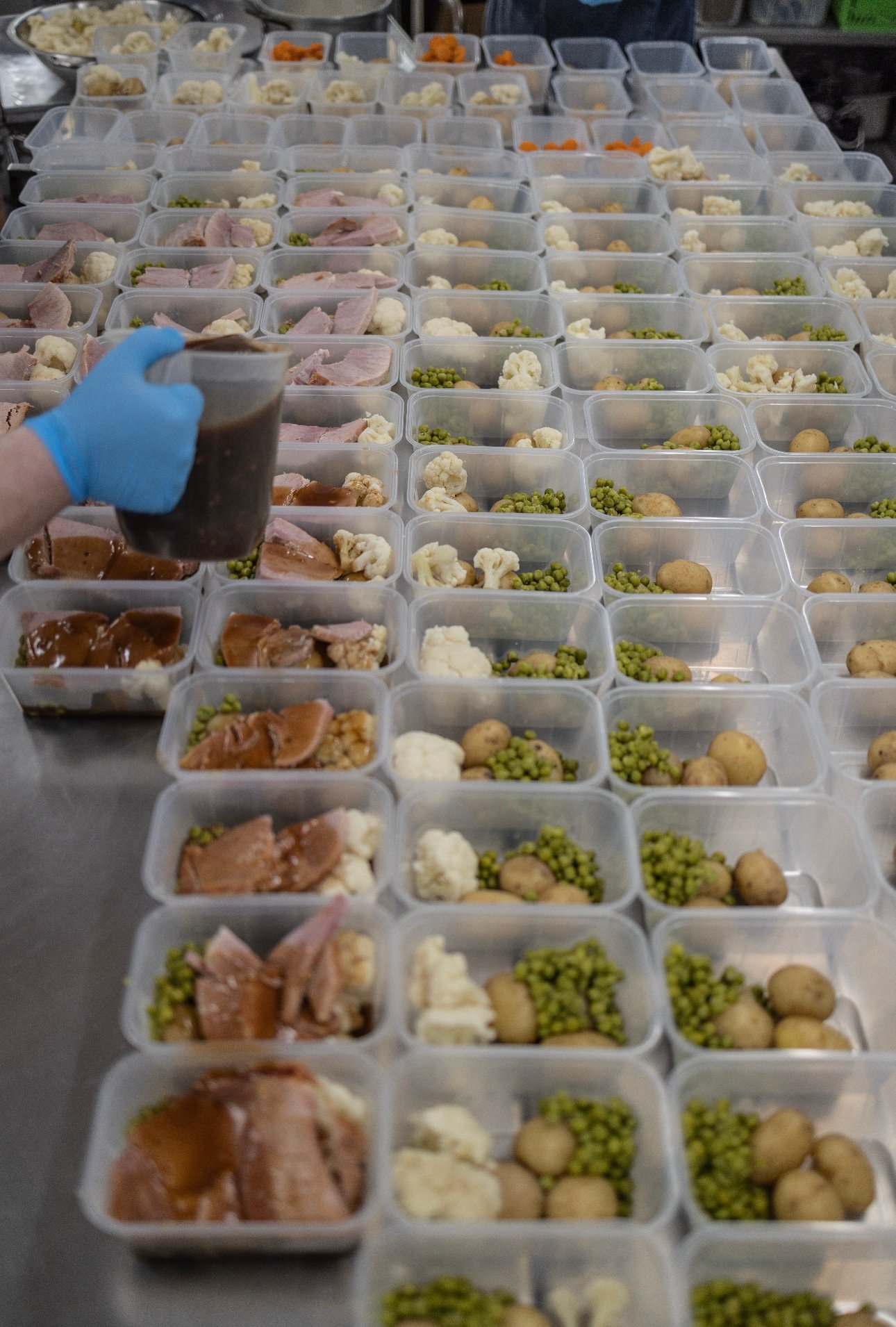
Meals are freshly prepared each morning by The Wishing Well team, before being delivered hot and ready to eat around lunchtime.
Charles explains that the service is particularly important for people living alone or in rural areas, where access to shops, cafés or other support may be limited. Some of the people reached live with a physical or mental health condition, while others have just been discharged from hospital.
But while freshly prepared food is central to the service, Charles is clear that what makes it distinctive is the welfare element.
Drivers may spend time chatting, checking someone is okay, helping with small practical tasks, or alerting family members if something seems wrong.
“Some of our customers just want the meal… whereas others, they’d like to have a cup of tea with you and like to have a chat.”
He describes small acts of support that are not always visible in formal service descriptions: changing a lightbulb, feeding a dog, or picking up post from the floor.
“If you’re walking into someone’s home and you’re quite literally standing over the mail, pick up the mail and give it to them… just do it, because these people that we’re reaching just need a helping hand...”
“I wish decision-makers and commissioners could just come and see the service. I wish they could come and walk into the kitchen or deliver some meals. Even if you’ve got the best impact report in the world… until you see it and feel it and get out there and do it, I don’t think it quite sinks in.”
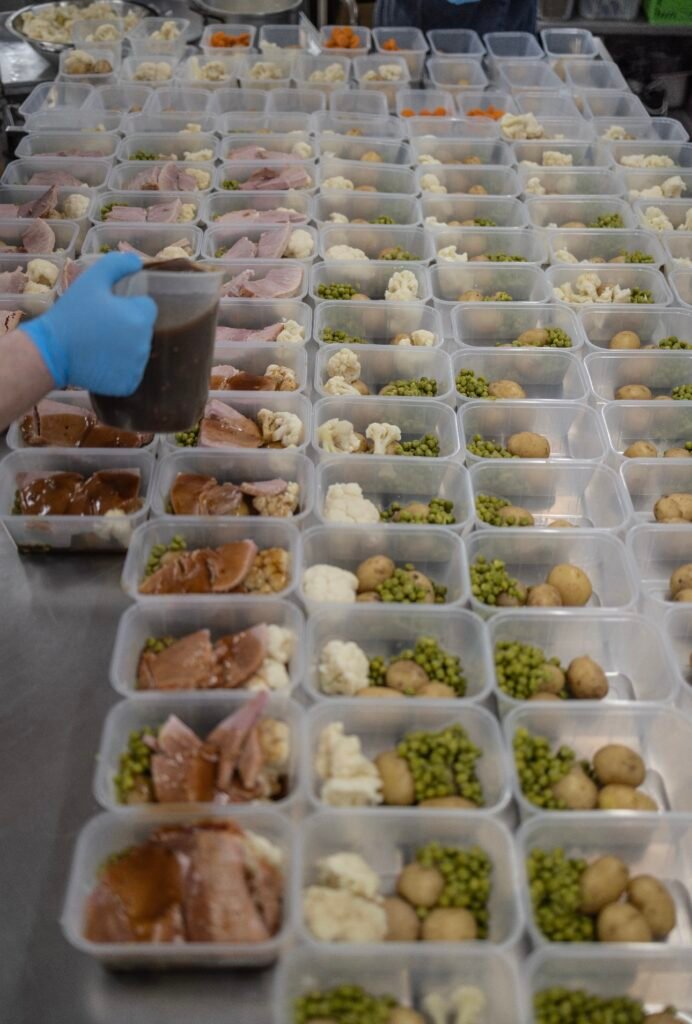
Image: Freshly prepared meals being portioned for the day’s deliveries at The Wishing Well.
“No one can go without their meal”
One of the strongest themes in our conversation is the team’s commitment to making sure nobody misses out.
The service depends on a combination of staff, volunteers and drivers. As with many Meals on Wheels services, last-minute changes can create pressure: staff illness, volunteer availability, holidays, route changes and new referrals all need to be managed day by day.
Charles describes the service’s approach simply:
“Our policy is that no one can go without their meal.”
That commitment means the team do whatever is needed to keep the service running.
For Charles, this hands-on culture is one of the organisation’s defining strengths.
“It’s what people do… Gill, colleagues, our Chair of the Board – he’s more than happy to go out and deliver meals… you roll up your sleeves and you get the job done.”
“We have grown, but we haven’t lost sight of who we are… whether it’s doing the garden, mopping floors, brushing, delivering meals, the basics – getting involved and getting it right.”
Helping people stay at home for longer
Gill describes the service as one part of a wider support package that helps people remain independent at home.
Families, social services and hospital discharge teams often look to the service as part of the support needed to help someone return home or stay at home safely.
“One of the main points is that we are able to keep a person in their home longer. A lot of the families and social services in Cheshire East put a package together to enable a person to live at home longer, and we are in that package.”
This can be especially important following hospital discharge.
“A lot of the discharge teams at the local hospital won’t let patients home until something’s put into place, like our Meals on Wheels.”
The service also provides reassurance to families who may not live nearby.
Gill gives the example of a customer whose phone was not working, leaving her unable to contact her son, who lives abroad. The team were able to help resolve the issue and reconnect her with her family. For Gill, this illustrates the wider role the service plays.
“It’s that connection with somebody knocking on the door and that friendly face and seeing somebody… plus the nutrition value of the meal.”
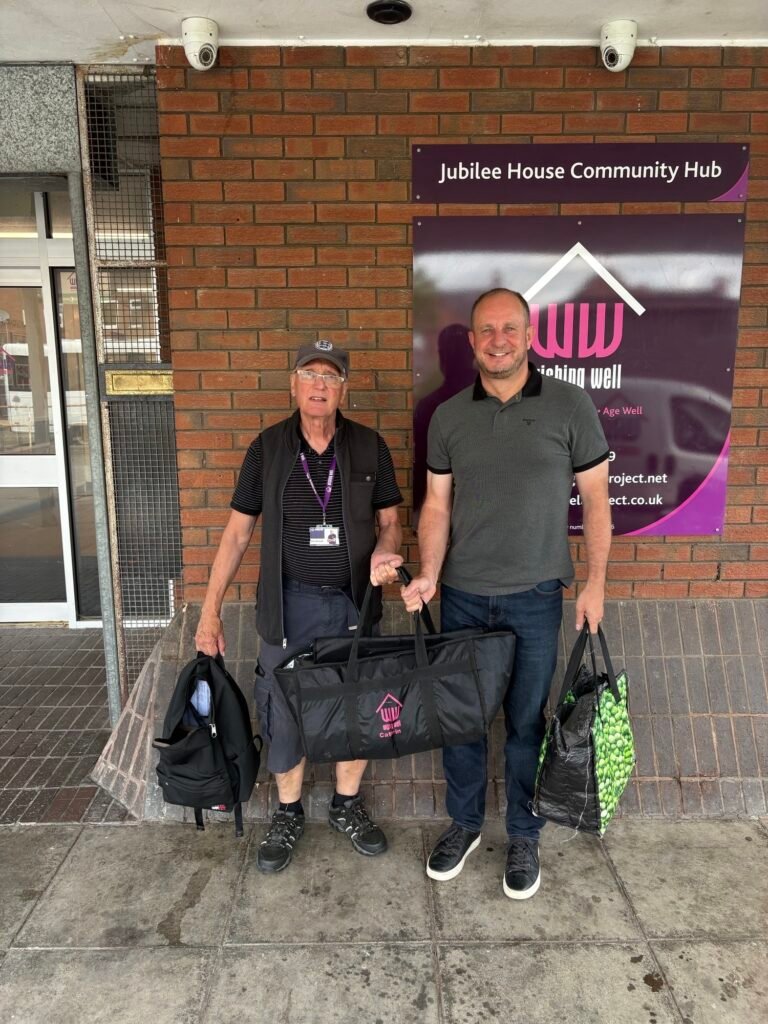
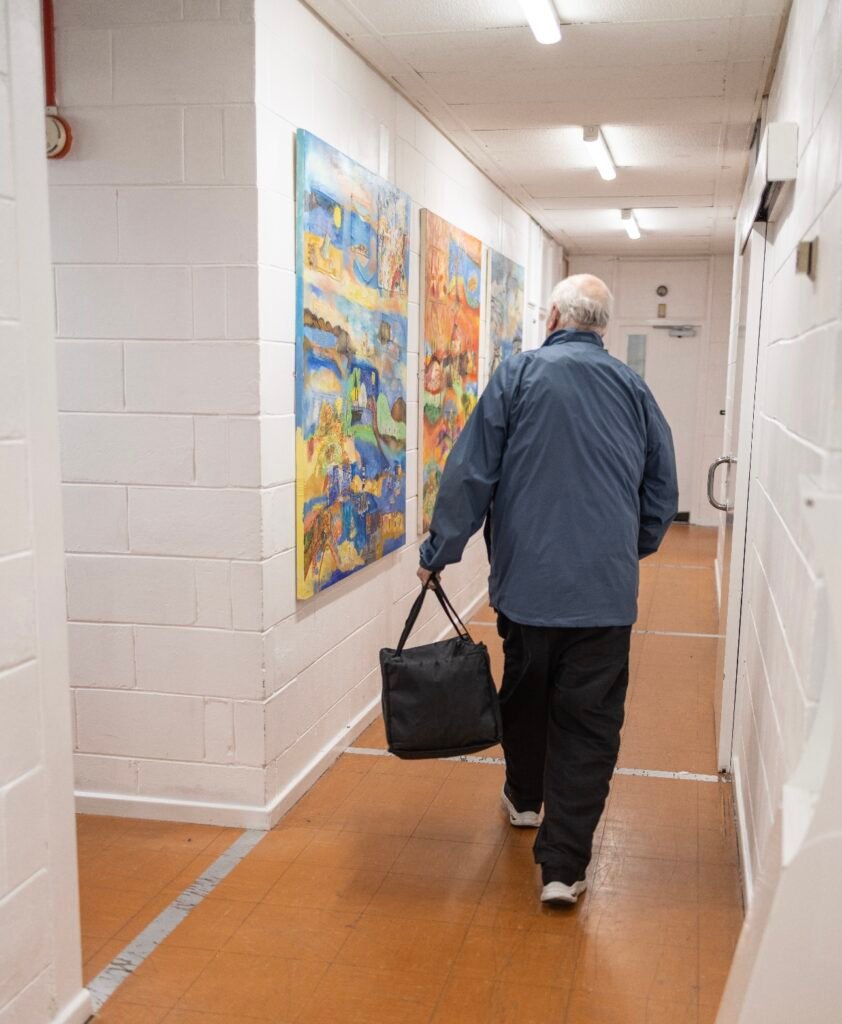
Ready to set off on a Wishing Well delivery round from the Jubilee House Community Hub
Built around people, not just processes
The Wishing Well has developed its Meals and Welfare service over many years, and Charles is clear that it has not been easy.
“It can be quite tough just from the operational side of things: managing the volunteers, managing the team, bringing the funding in, managing the supply chain.”
But he believes that challenge has made the service resilient.
“The project itself has become very resilient in its nature. So when the costs elevate… instead of it being panic stations… we ride this wave again.”
For a service supporting more than 100 people a day, stopping is not an option.
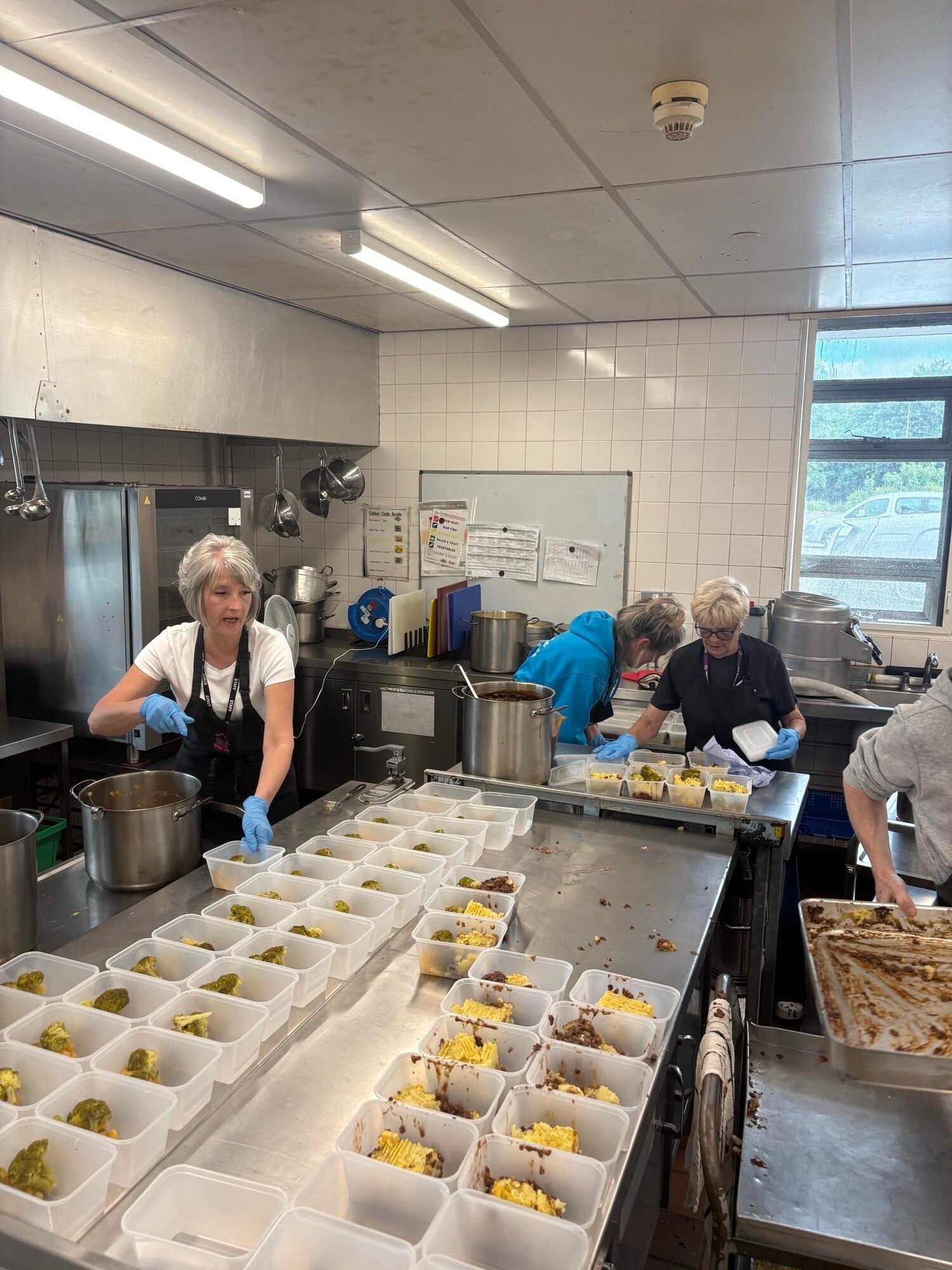
The Wishing Well kitchen team preparing meals for delivery
“For the 110, 120 people a day who get our meals at the moment, if we suddenly turned around to them and said, ‘Okay, well, that’s it now’, it’d be devastating.”
Practical systems that support personalised care
Although the service is strongly relationship-based, the team has also invested in systems to support day-to-day delivery.
Gill explains that they recently introduced a new meal database, developed with a local business that spent time understanding how the service works. The system now helps produce daily driver lists, kitchen lists, dietary information and preferences, and invoicing.
This has made it easier to manage dietary needs, allergies, dislikes and alternatives.
“We have a menu, and say for today it’s minced beef and potatoes and cauliflower. We’ll have at least five who don’t eat cauliflower, so we’ll send them something else out. And having quite a few alternatives each day is another thing that we pride ourselves on.”
The database also links with their financial system, helping the team produce invoices more efficiently.
“This new database is really, really good. It links into our financial database as well, so we can do invoices at the touch of a button.”
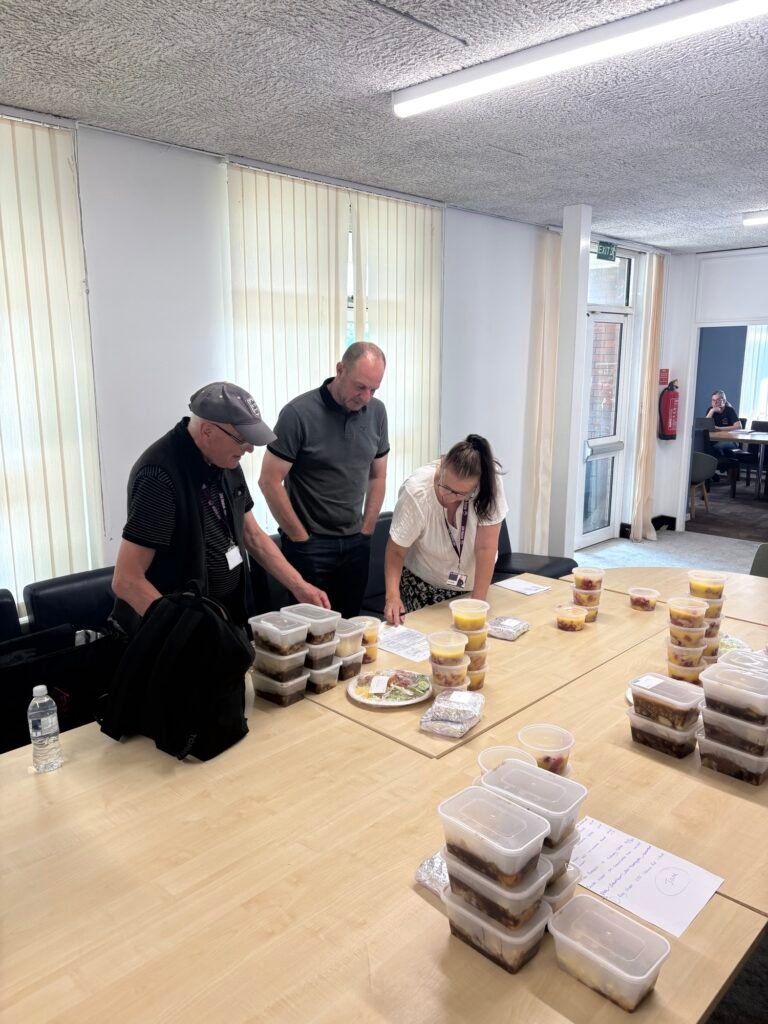
Meals are carefully checked and organised before each delivery round
Volunteers, training and emotional intelligence
Volunteers are essential to the service, whether supporting the kitchen or delivering meals.
The organisation keeps its volunteer application process simple, recognising that lengthy forms can be a barrier. It also provides safeguarding and first aid training, with further work underway to strengthen policies and procedures as the organisation grows.
Charles reflects that the team’s work often requires more than training alone. Drivers and volunteers may encounter people in difficult or distressing situations.
“Through our meal delivery service, we are supporting people towards end of life… our team have been brilliant.”
For him, much of this comes down to judgement, empathy and human qualities.
“That emotional intelligence, that understanding and empathy, which I’m not sure you can train… it’s actually just a human quality. So we’re very fortunate we’ve got these people in our team.”
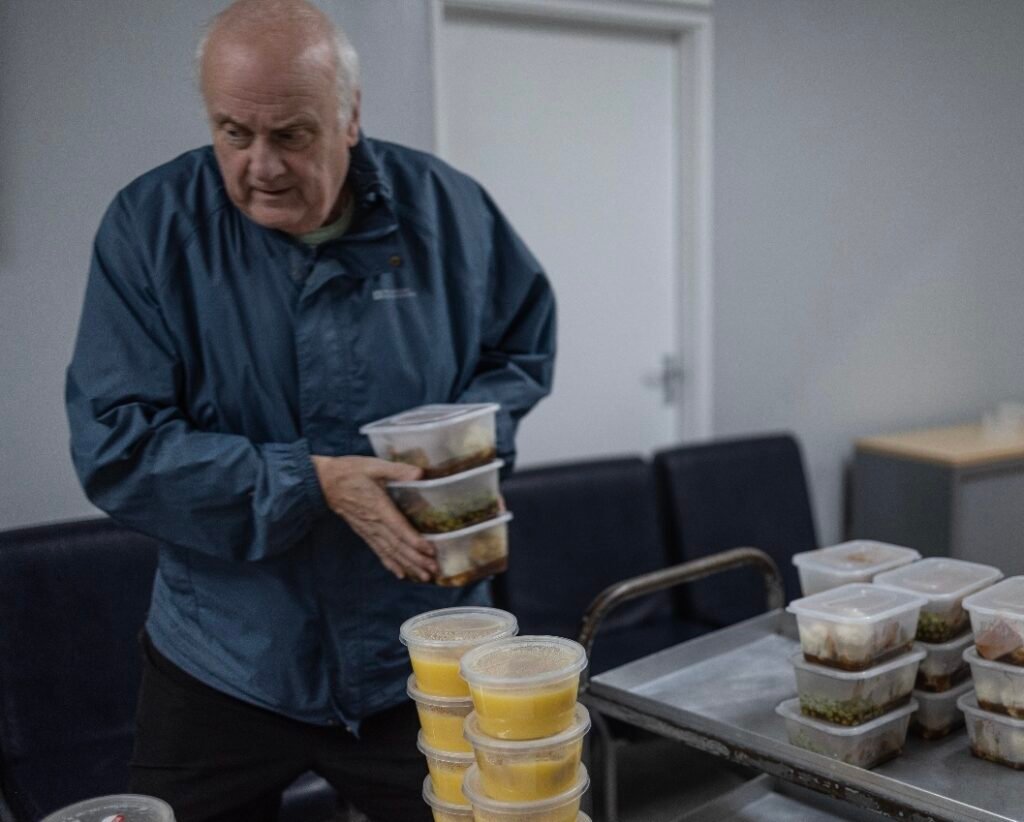
Packing meals ready to go out into the community
The constant reality of running the service
Gill describes the operational challenge of Meals on Wheels as constant.
Every day brings changes: people going into hospital, people coming home, cancellations, new customers, driver availability, family contact and last-minute adjustments.
“It’s a constant change. I’ve already had 20 messages this morning about people going into hospital or people coming home from hospital. Can they have a dinner? Can they be added to the list?”
She describes the need to stay alert at all times.
“You’ve got to keep your finger on the button at all times and every day, including weekends.”
When asked what would make running the service easier, Gill’s answer is immediate: funding and extra support.
“If we had more funding, more external help, we wouldn’t have to worry about it.”
More capacity would allow the team to coordinate more effectively, support shopping, help in the kitchen, and spend more time reaching out to families.
“When we take on a new person for meals, we also take on their family. We get to know them, what their needs are. It’s just all that extra support all the time.”
Funding, resilience and keeping meals affordable
Like many providers, The Wishing Well faces significant financial pressures.
The Meals and Welfare service is high impact, but also one of the organisation’s largest areas of expenditure.
“We’ve had significant support from external funders because they can see the value of it, they can see what we’re doing and see the impact.”
He is open with funders about the reality.
“When they’re asking us, ‘How is this going to carry on without the funding?’, the answer is, ‘It won’t. It’s reliant on that’.”
Charging the full cost of the service would make meals unaffordable for many people.
“Unless we go to a model which is £12 for a two-course meal… at the moment, it’s £6.50.”
Despite the challenges, Charles is clear that the service continues because the need is there.
“I think that’s what sets us apart. I know some projects would be very much, ‘Okay, we’ll have to close that then, we’ll have to cut that’. And we couldn’t do that. We couldn’t just say, ‘That’s it now.’ This is The Wishing Well’s flagship project. It’s where we reach the most people. So we’re very proud of that.”
A Wishing Well volunteer preparing meals for a delivery round
Why the service matters to the wider system
Charles sees The Wishing Well’s Meals and Welfare service as part of the wider health and care system.
The service helps people live better, longer lives at home, with dignity, surrounded by the people, pets and belongings that matter to them.
“We’re trying to help people live better lives, longer lives… trying to make people age well at home with dignity.”
He describes the human value first: helping individuals and families. But he also recognises the financial value to the wider system.
“We know it’s cheaper for the NHS if people are living at home and living independently and are not reliant on a hospital bed. We are quite literally saving the NHS money.”
But he always returns to the individual.
“What are we doing for that individual? What are we doing for that family? How are we helping that person?”
Showing impact when the work is the priority
Like many community organisations, The Wishing Well is working to strengthen how it captures and reports impact.
Charles acknowledges that charities are often very good at doing the work, but less confident or less resourced when it comes to evidencing it.
“Historically, we’re very good at doing what we do in terms of delivery. We’re not fantastic at reporting it. And I don’t think we’re alone in that.”
The organisation is introducing new systems to help capture data more easily, including a new CRM system. Charles hopes this will make it easier to show funders and commissioners the scale and value of the work.
“What I would like is, within a few clicks of a button, we’ve got at least the data there and I can then turn around to a funder and go, ‘We’ve delivered however many meals in the last 12 months’.”
But both Charles and Gill reflect that some of the most important work is difficult to capture. Gill explains:
“It’s the norm to us. It’s the norm to our volunteers. It’s the norm to our drivers… So we don’t report it, not because we don’t do it, but because it’s the norm.”
Charles believes that decision-makers, funders and commissioners need to see and feel the service for themselves to truly understand its value.
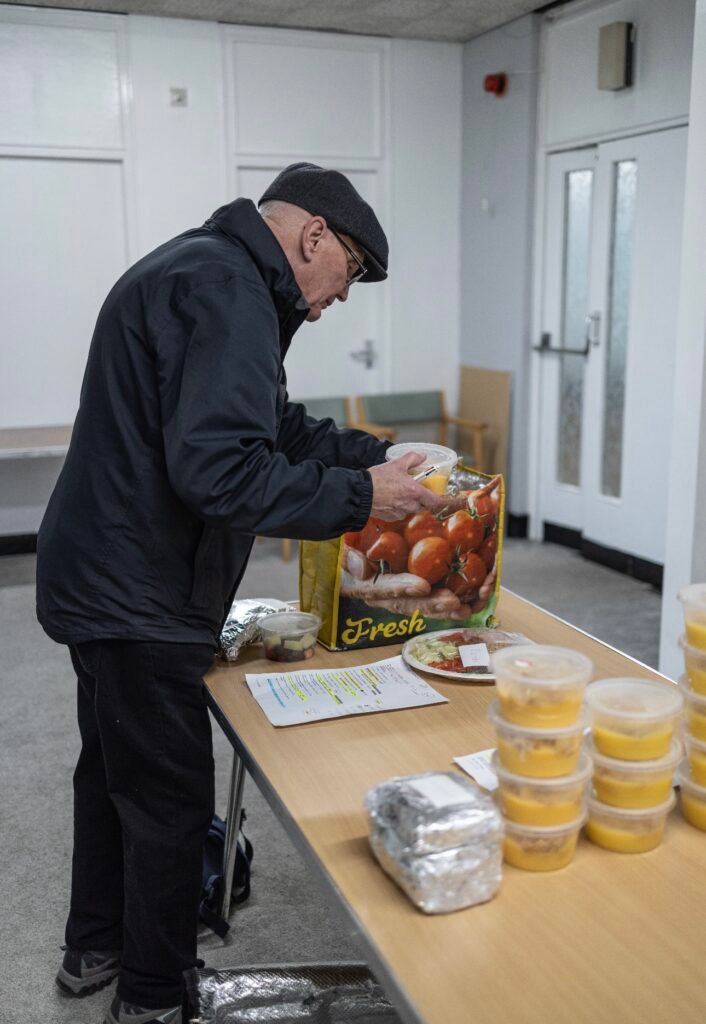
Heading out with meals for the day’s deliveries
Looking ahead
Looking ahead, Charles and Gill are focused on sustainability, resilience, and continuing to meet growing need across their area of operation.
The organisation is regularly approached by local authority and NHS colleagues from areas it does not currently serve, but expansion brings major challenges around funding, staffing, volunteers, vehicles and capacity.
Charles is open to learning from others and supporting other organisations where possible.
“We’re always looking for advice from other people… I’m sure there’ll be other ways that we can learn and do things in a better way or a smarter way.”
At the same time, he recognises that the strength of The Wishing Well lies in its local roots and hands-on culture.
“We can’t reach everybody. We can only reach people within our local area. So if we can support somebody else, that’s great, and if they can give us some advice, that’s also good.”
Advice for other providers
For people considering developing a new Meals on Wheels service, both Gill and Charles emphasise the importance of resilience, local knowledge, and staying close to the work.
“Get to know your people, not just the people that you’re serving in the community, but your team members, your volunteers, your staff. Find out what makes them tick.”
Charles warns that services need to be prepared for difficulty.
“The reason why The Wishing Well has been around for nearly 25 years, and the Meals and Welfare service has been around practically from the beginning, is because we’ve had a lot of knocks and a lot of times where you’re thinking, ‘How are we going to do this?’. And we typically find a way.”
His advice is simple:
“Get out there and deliver.”
For Charles, delivering meals himself early in his time at the organisation helped him understand what the service really meant.
“On day three, I started delivering some meals and I got it then. I was like, right, ‘Okay, this is what we do’.”
And if an existing Meals on Wheels provider came to The Wishing Well for advice, Charles encourages services to recognise the value of what they already do.
“If it’s working for you, then keep doing what you’re doing.”
Charles and Gill’s question to other Meals on Wheels providers
At the end of our conversation, Charles and Gill reflected on the importance of learning from other services:
“We’re always looking to see what other people are doing and if it’s good and we can perhaps bring it into what we’re doing, then fantastic. We’re always open to new ideas and ways of learning. I’d certainly be keen to have a conversation with other services because we’ve been through a pandemic and global crises and it’s almost like, ‘This is how we did it. How did you do it?’. And I’m sure there’ll be some things that we’ll align on and there’ll be some certain things that they’ll probably go, ‘I know that, we did it in this way’. It’s all about the community and how we can help each other.”
This reflects one of the strongest themes from our discussion: that Meals on Wheels services are strongest when they learn from one another. Whether navigating funding pressures, responding to changing demand, or supporting people to remain independent at home, there is considerable value in providers learning from one another and sharing what works in practice.
Do you run a Meals on Wheels service and have thoughts or experience to share? Join the conversation with other Meals on Wheels providers via our WhatsApp Community.